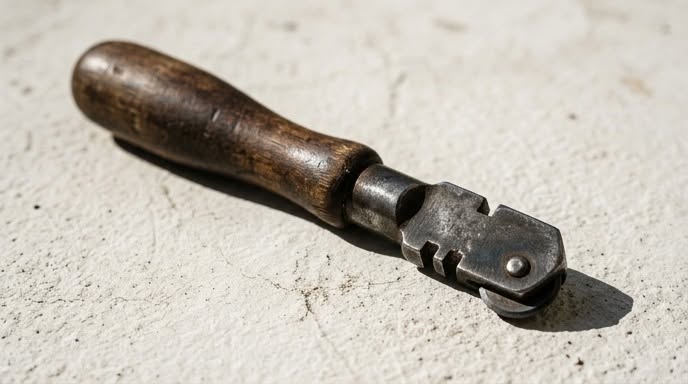
When clearing out multi-generational workshops or looking through boxes of rusty estate tools, you are bound to stumble upon objects that seem entirely mysterious. One tool that frequently leaves modern DIYers scratching their heads is a small, hand-held implement featuring a turned wooden handle, a tiny wheel at the tip, and a series of distinct square notches cut into its metal neck.
If you have one of these in your possession, you are holding an Antique Wheel Glass Cutter.
While the tiny wheel at the end has a clear mechanical purpose, it’s the side slots that usually spark intense debate online. Here is the fascinating history of this essential trade tool and the brilliant, unexpected reason behind those mysterious notches.
The Big Misconception: How Glass is Actually “Cut”
To understand why the tool is designed this way, you first have to unlearn the word “cut.” A hand-held glass cutter doesn’t actually slice through sheets of glass like a knife through cardboard. Instead, the tiny, hardened steel or tungsten carbide wheel at the tip is rolled firmly across the surface to create a “score line”.
This scoring action creates a highly controlled, microscopic fracture that breaks the surface tension of the glass. Once this shallow groove is made, the glass is primed to snap perfectly in two along that exact seam when a small amount of targeted downward pressure is applied.
The Secret of the Side Notches: Old-School “Nibblers”
If the wheel is responsible for making the line, what are those square notches on the side of the metal head used for?
Those slots are known in the trade as grozing or snapping notches. They are deliberately machined in varying widths (usually corresponding to standard glass thicknesses like 2mm, 3mm, or 4mm) to serve as a built-in lever system.
• How They Were Used
When a glazier scores a sheet of glass, they can typically snap the waste piece off cleanly using just their fingers. However, if the cut line is extremely close to the edge of the glass pane, or if they are cutting a complex inside curve for a stained-glass window, there isn’t enough surface area left for a human hand to grip and leverage.
Instead of risking a jagged shatter, the craftsman would slide the edge of the glass directly into the corresponding size notch. By applying a quick, gentle downward twist of the wooden handle, the notch acts as a perfect, precise fulcrum to cleanly snap the narrow strip of waste glass away along the scored line.
• Nibbling Away Imperfections
If the break wasn’t entirely perfect and left behind a tiny, jagged protrusion, the craftsman would use those same notches to safely “nibble” or chip away the rough edges—a process called grozing—until the glass fit flawlessly inside a wooden window frame or lead came.
ANATOMY OF A TRADITIONAL GLASS CUTTER
+-------------------------+-------------------------------------------------+
| Component               | Engineering Function                            |
+-------------------------+-------------------------------------------------+
| Hardened Steel Wheel    | Rolls firmly to create a controlled score line  |
| Graded Side Notches     | Grips thin or narrow edges to snap glass cleanly|
| Weighted Ball End       | Used to tap the underside to expand the fracture|
| Contoured Wooden Handle | Provides optimal grip and downward hand pressure |
+-------------------------+-------------------------------------------------+
The Bottom Line
Today, most professional glaziers and stained-glass hobbyists utilize separate specialized tools, like dedicated running or grozing pliers, to snap their glass. But for over a century, this single, compact multi-tool was the undisputed king of the glazing trade.
Finding an original, weathered wood-handled glass cutter is a wonderful tribute to the simple, clever engineering of early hand tools—built to solve multiple problems with a single piece of molded steel.