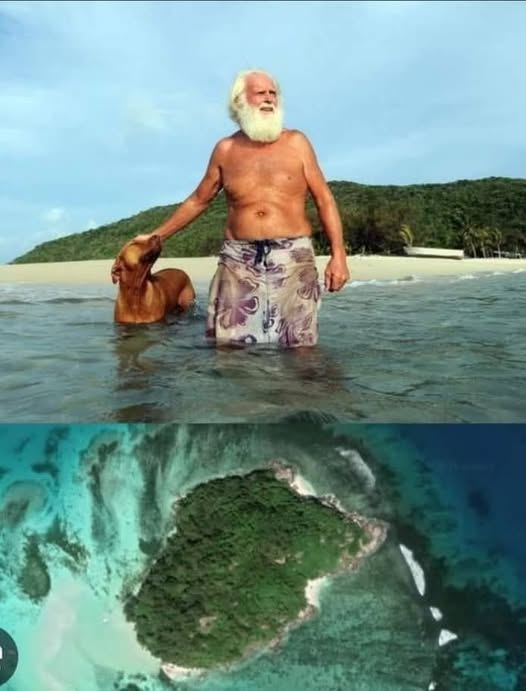
Imagine making a decision in the last four minutes before midnight that would change your entire life—and create a sanctuary for thousands of living creatures you’d never even met yet. That’s exactly what happened to Brendon Grimshaw, a 37-year-old British newspaper editor, on the final night of a 1962 vacation in the Seychelles.
What started as a spontaneous purchase of an overgrown, abandoned island would become a 50-year mission to restore an ecosystem, prove that one person can make an immeasurable difference, and demonstrate the power of choosing purpose over profit.
The Moment Everything Changed
In 1962, Brendon Grimshaw was on his second-to-last day in the Seychelles when a man approached him asking if he would be interested in buying an island. The price: £8,000 pounds, roughly $10,000 dollars at the time. In most people’s lives, that conversation would be interesting dinner table talk and nothing more. But Grimshaw wasn’t most people.
Just hours later—four minutes to midnight on the last day of his stay—Grimshaw signed an agreement to pay £8,000 to the owner, Philippe Georges, to take ownership of Moyenne Island. The island was small: only 400 meters long by 300 meters wide, nestled 4.5 kilometers off the north coast of Mahé, Seychelles’ largest island.
Why He Was Ready to Leave Everything Behind
Grimshaw’s decision to buy the island wasn’t random. Tanzania had become independent from Britain in 1961, and Kenya was about to follow. Jobs like Grimshaw’s as a newspaper editor would soon pass to locals, so Grimshaw started thinking about his next move. Rather than simply moving to another position, he decided it was time to pursue something bigger—a life closer to nature, a purpose he could fully commit to.
The Seychelles had captivated him on a previous visit. When the opportunity fell into his lap in those final hours before departure, Grimshaw recognized it for what it was: the beginning of his life’s work.
The Island Nobody Wanted
When Grimshaw first took ownership of Moyenne Island, it was in rough condition. The island had been abandoned and forgotten for approximately 50 years by 1962, heavily overgrown with weeds and void of birds. It wasn’t a tropical paradise—it was a reclamation project that would have discouraged most people after the first day.
But Grimshaw wasn’t alone in his vision. He brought with him René Antoine Lafortune, a local Seychellois man, who became his closest collaborator. While he may not have lived with Brendon at first, he came regularly so they could complete work that would have discouraged many.
The Back-Breaking Work Begins
In 1973, Grimshaw moved to his island with nothing but a dream, and together with Rene Lafortune, he commenced a 40-year long labour of love. What this means in practical terms is extraordinary. Every single day, two men set out to restore an entire island ecosystem.
Together they planted palm trees, mango and paw-paw trees. They saved rainwater and pumped it up the hillside by hand, or rowed back to the main island to collect barrels of fresh water. It was backbreaking, exhausting work, with Brendon’s hands covered in blisters.
There were no machines, no construction crews, no modern shortcuts. Just two men, basic tools, and an unwavering commitment to a vision.
The Numbers Behind the Miracle
When you hear about restoration projects, the scale can feel abstract. With Moyenne Island, the numbers make the achievement staggering.
16,000 Trees, Planted by Hand
Over the intervening years, Grimshaw and Lafortune planted 16,000 trees by hand, including 700 mahogany trees that have grown to reach 60-70 feet in height. To put this in perspective, that’s roughly one tree per day for over 40 years, planting each one manually, caring for each one, watching them grow.
Brendon Grimshaw kept a detailed record of every plant they introduced to the island. This wasn’t careless work—it was meticulous, thoughtful restoration guided by someone who understood that ecological recovery requires patience and attention.
Miles of Paths Built by Brute Force
Grimshaw and Lafortune constructed some 4.8 kilometers of nature paths across the island. Every inch of those paths was cleared, leveled, and maintained by hand. No heavy equipment. No crews. Just persistence.
2,000 Birds Return to an Empty Island
Perhaps the most remarkable achievement is what Grimshaw accomplished with the island’s animal population. When he arrived, Moyenne was silent. Birds had abandoned it completely. Grimshaw brought 10 birds over from a neighboring island, to which they swiftly flew back. He did the same thing again and thought he got the same result. But then a few birds returned, and Grimshaw and Lafortune began feeding those first avian residents. Slowly, more settled on the island. As the new trees grew and produced fruit, more birds came. Now 2,000 birds live on this little slice of paradise.
The lesson is profound: restoration isn’t about a single dramatic gesture. It’s about creating conditions for life to return—about patience, about feeding the first arrivals even when others leave, about building the ecosystem that will naturally attract living things.
The Temptation That Proved His Character
By the 1980s and 1990s, Moyenne Island’s transformation was complete. Tourism was booming in the Seychelles, and developers were eager to turn pristine islands into luxury resorts. The offers came in constantly.
One of those offers came from a Saudi prince, who offered Brendon Grimshaw as much as $50 million—but his response was short and clear: “The island is not for sale.” To every investor, Grimshaw would first ask, “What will happen to the tortoises?”, “Where will the birds nest?”, “What about the fauna?”. Simply put, money didn’t interest him, because he knew from the beginning that he was on a life mission.
Fifty million dollars. That’s wealth most people only dream about. That’s early retirement, luxury, comfort, legacy for family members. Grimshaw had spent decades of back-breaking labor to create something beautiful. He could have sold, lived in comfort, and let someone else decide the island’s fate.
He refused.
His reason was simple: He said, “I don’t want the island to become a favorite vacation spot for the rich. Let it be a national park where everyone and animals can live and have fun freely.”
The Legacy He Left Behind
In 2007, Rene Lafortune, Grimshaw’s companion of 45 years, passed away. Grimshaw was now 81, living alone on his island, knowing his own time was limited.
Rather than seeing this as a reason to sell or abandon his mission, he took action to ensure the island would be protected forever. He struck a deal with the Seychelles’ Ministry of Environment to make Moyenne Island a national park in 2009. Today, it’s considered the smallest national park in the world.
According to regulations established by the Moyenne Island Foundation, no more than 50 visitors are allowed on the island at any one time—even during peak tourist season. And although a rest-stop was erected for visitors, there is no hotel development or other forms of private land ownership.
A Living Monument to One Man’s Vision
Now more than a decade after Grimshaw’s death, the island of Moyenne remains just as he left it—undeveloped and teaming with nature’s diversity—thanks to his tremendous efforts. One visitor described Moyenne as, “a riot of green against cobalt skies and a sapphire sea, like a tiny rainforest erupting from the ocean.”
By one estimate, Moyenne is home to more plant species per square mile than any other national park in the world. The ecosystem Grimshaw and Lafortune created through five decades of manual labor has become one of the most biodiverse places on Earth, protected in perpetuity.