
Have you ever looked closely at an optical illusion and realized that what you see is completely different from what your friend sees? Brain teasers, visual riddles, and abstract puzzles have taken social media by storm, but few capture the internet’s attention quite like shape-counting personality tests.
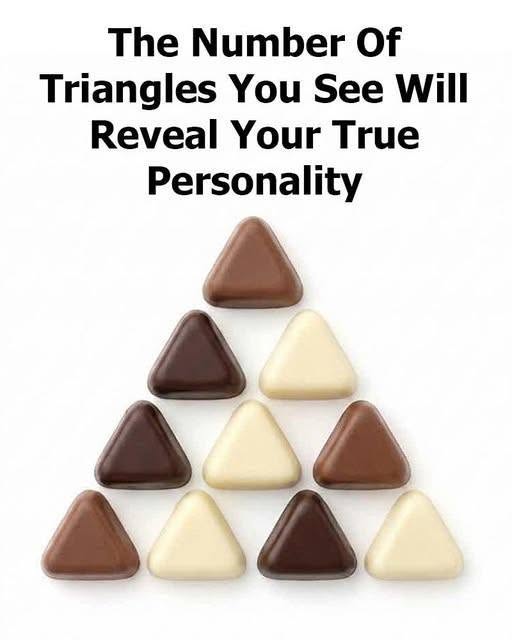
This viral image features a series of triangular chocolates stacked carefully into a pyramid shape. But don’t let the simplicity trick you—counting these shapes is harder than it looks!
Depending on how your brain processes patterns, the number of triangles you count can reveal fascinating insights into your subconscious, cognitive processing style, and overall personality type. Look closely at the image, count the triangles, and find your results below!
The Big Reveal: How Many Triangles Are Actually There?
Before we dive into what your count says about your inner traits, let’s look at the mathematical reality of this puzzle.
- The Individual Pieces: There are exactly 10 small, individual triangular chocolates arranged in a pyramid formation ($1$ on top, $2$ in the second row, $3$ in the third, and $4$ at the base).
- The Large Cluster: If your eyes scale backward, the individual pieces combine to form 1 massive composite triangle making up the entire stack.
- The Hidden Groups: Depending on how you cluster the overlapping rows (such as groups of three or six chocolates), sharp eyes can find intermediate nested triangles.
Let’s break down exactly what your final count says about how your brain functions.
Personality Analysis: What Your Count Says About You
If You Counted 1 to 9 Triangles: The Big-Picture Visionary
If you counted fewer than 10 triangles, your mind doesn’t like to get bogged down by tedious micro-details. Instead, you focus on the broader strokes of a situation.
- Your Personality Type: You are a creative, fast-paced thinker. You value efficiency and are excellent at brainstorming grand ideas, launching new projects, and seeing the ultimate goal.
- Core Strengths: You rarely get stressed over minor complications, and you excel at leading teams by delegating tasks to those who enjoy the fine print.
- Blind Spots: Sometimes, you can overlook crucial minor steps or details in a plan. Taking a moment to double-check your work can save you time in the long run.
If You Counted Exactly 10 Triangles: The Realistic Pragmatist
Counting exactly 10 triangles means you saw the individual pieces laid out clearly in front of you. You look at the world exactly as it is without overcomplicating things.
- Your Personality Type: You are grounded, reliable, and logical. You prefer facts over assumptions and appreciate clarity, transparency, and structure in both your professional and personal life.
- Core Strengths: You are incredibly dependable. When given a task, people trust you to execute it correctly because you follow guidelines and maintain an organized workspace.
- Blind Spots: You might occasionally struggle with “thinking outside the box.” Don’t be afraid to question standard rules and explore unconventional paths to success.
If You Counted 11 to 13 Triangles: The Analytical Perfectionist
If you saw the 10 individual pieces plus the single massive pyramid shape (making 11), or found additional hidden configurations, you possess a highly analytical mind.
- Your Personality Type: You are a perfectionist, a deep thinker, and naturally curious. You possess an innate ability to read between the lines, spot hidden patterns, and see solutions that others miss completely.
- Core Strengths: Your problem-solving skills are top-tier. You are excellent at careers involving strategy, data, editing, or complex planning because your attention to detail is unmatched.
- Blind Spots: You have a strong tendency to overthink situations. This can occasionally lead to “analysis paralysis,” where you hesitate to make a final decision because you’re looking for hidden flaws.
The Science Behind Visual Personality Quizzes
Why do thousands of users participate in these optical illusions every day? Psychologists suggest that visual puzzles tap into our innate desire for self-discovery and validation.
In cognitive psychology, the way you count these shapes is connected to Gestalt principles of visual perception. Some brains naturally group similar objects together (such as grouping the dark chocolate pieces vs the white chocolate ones), while other brains focus entirely on the whole structure.
While these internet tests shouldn’t replace a professional psychological evaluation, they are an excellent, lighthearted way to challenge your cognitive boundaries, practice mindfulness, and understand how your unique mind interprets the world around you.
What was your final score?
Share this puzzle with your friends or family to see if they spot the hidden configurations, or use it as a quick morning brain exercises to kickstart your focus for the day!