There is something deeply comforting about a classic dessert that has been passed down through generations. While trendy pastries come and go, nothing quite matches the timeless elegance of a perfectly baked, silky-smooth Vanilla Flan (also known as Crème Caramel).
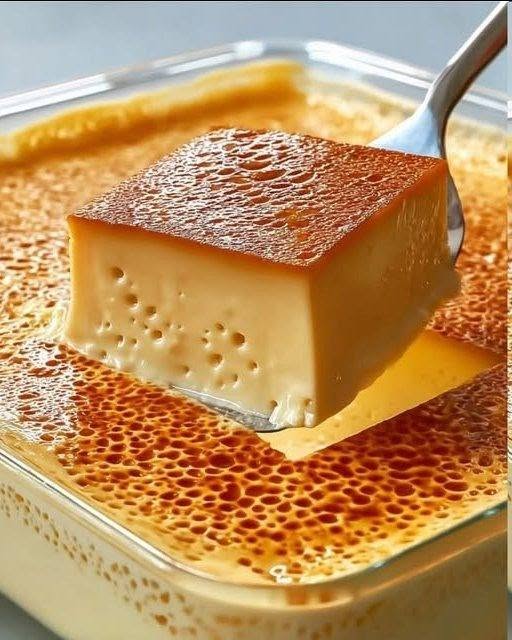
Whenever this picture hits social media, it instantly triggers a wave of nostalgia. Everyone remembers their grandmother or mother pulling this golden, shimmering masterpiece out of the refrigerator on Sundays or special holidays.
But let’s be honest: while flan looks incredibly simple with its short ingredient list, it can be intimidating to make. How do you get that deep amber caramel without burning it? How do you achieve that perfect, rich, traditional texture without it turning into sweet scrambled eggs?
Today, we are stripping away the mystery. Here is the secret history behind Grandma’s foolproof method, why it works every single time, and how you can replicate this showstopping dessert in your own kitchen.
The Anatomy of a Perfect Flan: Traditional vs. Modern
If you look closely at a truly authentic, homemade flan, you will notice a gorgeous, rich body that holds its shape beautifully on a spoon. Unlike mass-produced, gelatin-heavy restaurant versions that look like shiny plastic, a traditional baked flan features a rustic, velvety crumb with tiny pockets that trap the liquid caramel.
Achieving this signature texture relies on a delicate balance between two main components:
1. The Liquid Gold (The Caramel)
The base of any great flan is a flawless caramel layer. It requires melting pure white granulated sugar down until it liquefies into a deep, reddish-amber syrup. If it’s too light, it will just taste like sweet syrup; if it’s too dark, it becomes bitter. Grandma always knew exactly when to pull it off the heat—right when it smells intensely rich and smoky, just before it begins to smoke.
2. The Custard Framework
Traditional recipes rely heavily on a combination of whole eggs and high-quality milk bases. Many classic Latin and Mediterranean variations use a mix of condensed milk (for dense, rich sweetness) and evaporated milk (for structural stability without wateriness). When whisked with real vanilla extract, this creates an incredibly stable custard that bakes into a sliceable dream.
The Secret Technique: The Low-and-Slow Water Bath
If there is one absolute rule to making a flawless flan, it is the Bain-Marie (water bath).
You can never bake a flan with direct oven heat. Because eggs are incredibly sensitive to temperature, direct dry heat will cause the proteins to tighten up too quickly, forcing out water and creating a rubbery, curdled mess.
By placing your baking dish inside a larger pan filled with hot water, you insulate the custard. The water acts as a protective shield, keeping the cooking temperature strictly around 100°C (212°F). This ensures the eggs coagulate into a smooth, uniform, delicate gel that melts completely on your tongue.
💡 Pro Tips for a Flawless Flip
The most nerve-wracking part of making a flan is the final inversion onto a serving platter. To ensure your flan slips out smoothly without breaking:
- Be Patient: Never try to flip a warm flan. It must chill in the refrigerator for at least 4 hours (preferably overnight). This allows the custard to set completely and gives the hardened caramel time to turn into a luscious, liquid sauce.
- The Knife Trick: Run a thin, sharp knife around the inside edge of the dish before flipping to break the vacuum seal.
- Commit to the Flip: Place your serving rimmed platter firmly over the top of the baking dish, hold both tightly, and invert them in one swift, confident motion. You will hear a satisfying pop as it releases!
Why This Recipe Beats Modern Variations
Modern quick-fix recipes often use gelatin or cornstarch to thicken the milk without baking. While it saves time, it completely ruins the soul of the dessert. A true, old-fashioned flan relies solely on the natural binding power of eggs to achieve its luxurious density. When you take a bite of a real baked flan, it shouldn’t bounce like jello—it should velvet over your palate, perfectly balanced by the slight bitterness of the burnt sugar syrup.
Ready to fill your kitchen with the sweet aroma of caramelized sugar and warm vanilla? The entire, step-by-step traditional recipe—complete with exact measurements and oven settings—is pinned right below!
Did your grandma make flan like this?
What was your family’s secret ingredient—a splash of rum, a pinch of orange zest, or pure traditional vanilla? Check out the full recipe in the first comment below, try it out this weekend, and drop a comment to tell us how your flip turned out!
📌 Copy & Paste: First Comment Recipe to Pin on Facebook
👵 GRANDMA’S TRADITIONAL VANILLA FLAN RECIPE 🍮
Here is the exact, foolproof recipe to recreate this melt-in-your-mouth classic! Save this comment so you don’t lose it!
🛒 INGREDIENTS:
For the Caramel:
- 1 cup granulated sugar
- 1/3 cup water
For the Custard:
- 1 can (14 oz) sweetened condensed milk
- 1 can (12 oz) evaporated milk
- 5 large eggs (at room temperature)
- 1 tablespoon pure vanilla extract
- 1/16 teaspoon (a tiny pinch) of salt
👩🍳 STEP-BY-STEP INSTRUCTIONS:
- Make the Caramel: In a heavy saucepan, combine sugar and water over medium heat. Do not stir! Just swirl the pan occasionally. Watch it closely as it turns from clear to golden, then to a deep reddish-amber. Immediately pour the hot caramel into your baking dish (an 8 or 9-inch round cake pan or glass dish). Swirl quickly to coat the bottom, then let it cool and harden.
- Preheat & Prepare: Preheat your oven to 175°C (350°F). Boil a kettle of water for your water bath.
- Mix the Custard: In a large bowl, gently whisk the eggs, condensed milk, evaporated milk, vanilla, and salt until completely smooth. Tip: Whisk gently by hand rather than using a high-speed blender to avoid creating too many air bubbles!
- Pour & Strain: Strain the mixture through a fine-mesh sieve directly into your caramel-lined pan to catch any stray egg bits. This guarantees that ultra-smooth finish.
- The Water Bath (Bain-Marie): Place your flan pan inside a larger, deep baking pan (like a roasting pan). Carefully pour the boiling water into the outer pan until it reaches halfway up the sides of the flan dish.
- Bake: Bake for 50 to 60 minutes. The edges should look set, but the absolute center should still have a slight, gelatinous jiggle when nudged.
- Chill Before Flipping: Remove from the water bath and let it cool to room temperature. Then, cover with plastic wrap and refrigerate for at least 4 hours (overnight is best!).
- The Big Flip: Run a knife around the edges, place a large rimmed plate over the top, flip quickly, and let that gorgeous caramel cascade down the sides!
Enjoy a slice of pure heaven! ❤️ If you love old-school recipes, drop a ‘YUM’ and share this post! 👇