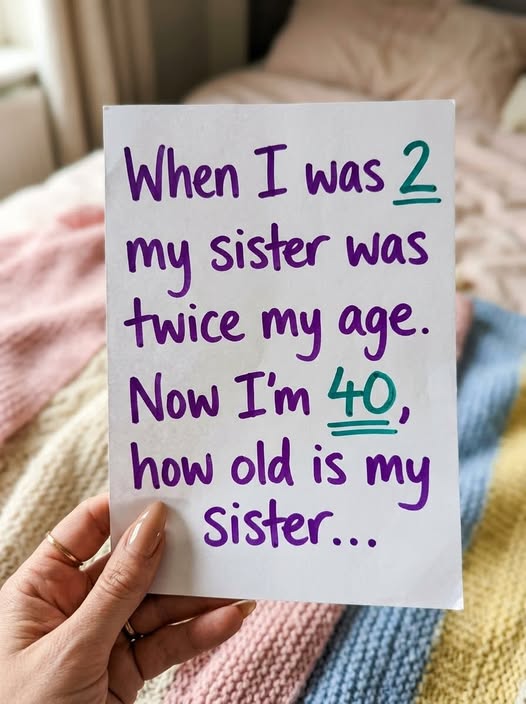
Brain teasers like the one featured in image_dc04d7.jpg have become a staple of social media, capturing the attention of millions. At first glance, they seem simple, often designed to trick our intuition. However, beneath the surface of these puzzles lies an interesting intersection of psychology, cognitive function, and the way we process information. Engaging with these puzzles is not just a way to pass the time; it is a mental exercise that can sharpen focus and improve problem-solving skills, which are essential in high-stakes fields like Finance, Education, and Business.
The Psychology Behind the Trick
The puzzle in image_dc04d7.jpg is a classic example of how our brains are prone to cognitive biases. When we read “When I was 2, my sister was twice my age,” our brain quickly performs the multiplication and arrives at “4.” When we then read “Now I’m 40,” the brain tends to continue with the established pattern, leading to the incorrect answer of “80.”
This happens because our brains favor “system 1” thinking—which is fast, instinctive, and emotional—over “system 2” thinking, which is slower, more deliberative, and logical. By challenging ourselves with these puzzles, we train our minds to pause and engage in more analytical reasoning.