
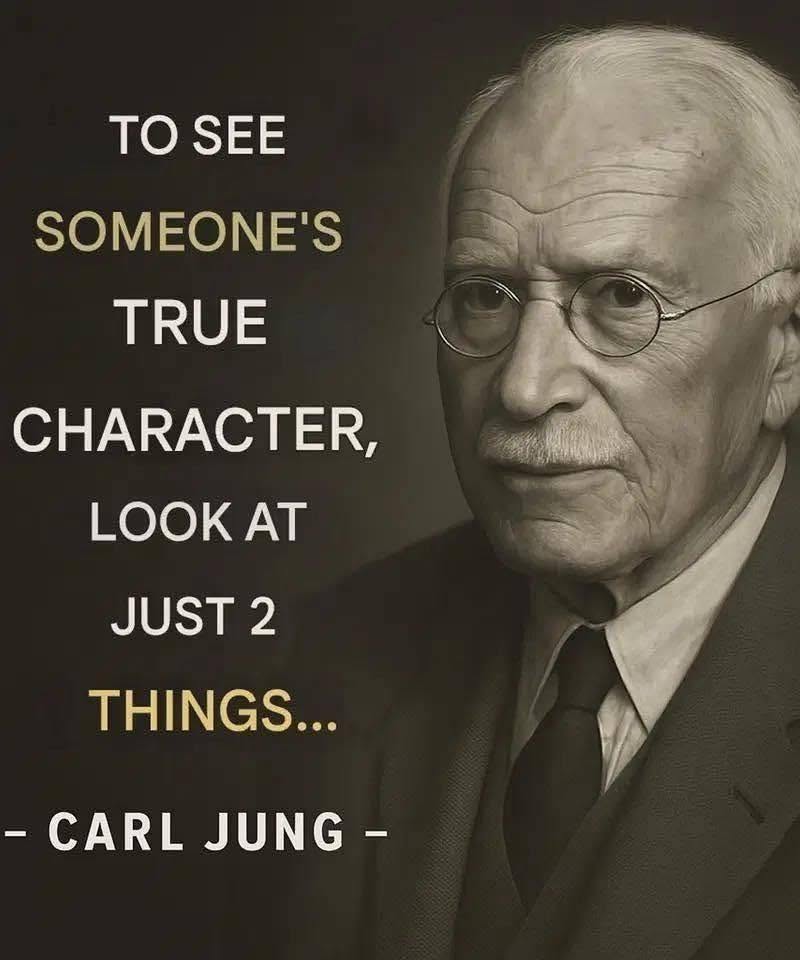
In image, we are presented with a thought-provoking prompt from the Swiss psychiatrist and psychoanalyst Carl Jung. Jung spent his life exploring the depths of the human psyche, and his work remains foundational to our understanding of personality and behavior. When he suggests that true character can be revealed by observing just two things, he is inviting us to look beyond surface-level interactions.
The Two Pillars of Character
While the image in image_9dfddf.jpg leaves the “2 things” as an open-ended mystery to pique curiosity, in the context of Jungian philosophy, these are often interpreted as:
- How They Act When They Have Everything: This observes how a person handles success, abundance, and power. A person’s true character is tested by their capacity for humility, generosity, and responsibility when they are at their peak.
- How They Act When They Have Nothing: This observes how a person handles loss, stress, and adversity. True character is often revealed in the resilience, integrity, and grace a person maintains when the circumstances of their life become difficult.
Why Context Defines Character
Jung’s perspective emphasizes that personality is not a static trait; it is dynamic and context-dependent. We often judge others by their public persona, but Jung argues that we only truly know someone when we see how their values hold up under extreme conditions—both the best of times and the worst of times.
Applying Jung’s Wisdom to Daily Life
Understanding this can change how we approach our personal and professional relationships.
- Practice Observation: Instead of focusing on words, focus on actions during high-stress or high-reward situations.
- Self-Reflection: Ask yourself how you behave during your own moments of triumph and defeat. Are you acting in alignment with your values, or are you reacting based on external pressure?
- Build Integrity: Whether in business or personal life, building a character that remains consistent regardless of the situation is the ultimate goal of psychological growth.
Conclusion
The wisdom shared in image_9dfddf.jpg serves as a timeless reminder to look deeper into the nature of the people around us—and ourselves. True character is not found in the mundane, but in the extremes of life. By paying attention to how we act in those moments, we can gain invaluable insights into the human condition.
FAQ Section
Q: Why is it hard to see someone’s “true” character?
A: People often wear a “persona”—a social mask that allows them to function in society. Seeing true character requires observing someone when that mask has the potential to slip, such as during high stress or great success.
Q: Can character be changed?
A: Jung believed in the process of “individuation,” where a person integrates the different parts of their psyche over time. Through self-awareness and effort, it is possible to refine and develop one’s character throughout life.
Q: What is the benefit of understanding Jung’s philosophy?
A: It provides a framework for deeper self-understanding and more empathetic interactions with others, helping us move past snap judgments to a more profound appreciation of human complexity.