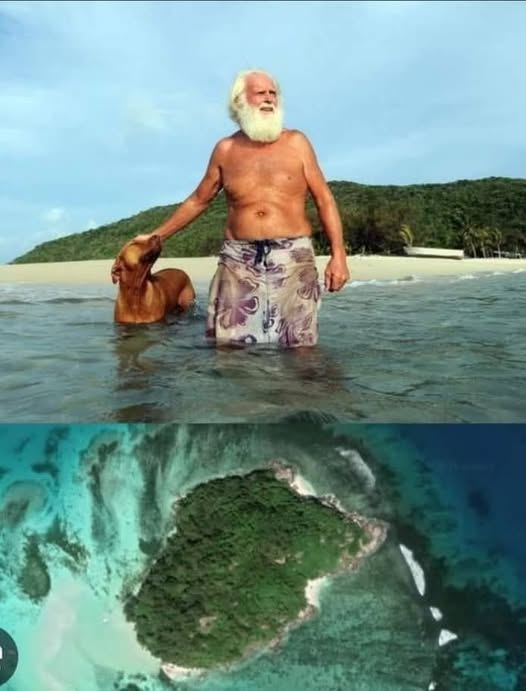
Brendon Grimshaw’s story carries lessons that extend far beyond island restoration. His life demonstrates several truths we often forget in modern life:
One Person Can Make an Immeasurable Difference. Grimshaw didn’t have an army of workers or cutting-edge technology. He had a vision, a partner, and persistence. Those three things transformed a dead island into a thriving sanctuary.
Time Is More Valuable Than Money. When offered $50 million, Grimshaw chose to keep something he’d spent decades building. He understood that some things can’t be replaced once they’re gone, and money alone can’t buy them back.
Consistency Matters More Than Intensity. Grimshaw didn’t plant 16,000 trees in one heroic effort. He planted them, one after another, for 40 years. He didn’t restore the ecosystem in a season—he dedicated his entire life to it.
Your Legacy Can Outlast You. Grimshaw died on July 3, 2012, at age 86. But everything he built remains. The trees he planted are still growing. The birds he welcomed are still nesting. The tortoises he introduced are still thriving. His work transcends his lifetime.
The Broader Context: Ecological Restoration in Our Time
Grimshaw’s project predates modern conservation movements by decades. He wasn’t a trained ecologist working with grant funding or government resources. He was a newspaper editor with a dream and a shovel. Yet his approach—working with natural systems rather than against them, introducing species gradually, building habitat before expecting wildlife to arrive—aligned with principles that conservation scientists would only formalize years later.
In an era of climate change and habitat loss, Grimshaw’s story offers something more than inspiration: it offers a practical example of how ecological restoration actually works. It’s slow. It requires commitment. It demands patience. But it works.
Interesting Facts About Moyenne Island
- The island is just 9.9 hectares (about 24 acres)—small enough to walk across in less than an hour, yet packed with enough biodiversity to rival much larger nature reserves
- The island now hosts nearly 50 giant Aldabra tortoises, a species that was approaching extinction
- Grimshaw published the story of his connection with Moyenne as a book, ‘A Grain of Sand’ in 1996, and has over the years been the subject of many documentaries
- Despite being the world’s smallest national park, Moyenne Island is considered one of the most ecologically important
Common Mistakes People Make When Thinking About Conservation
Many people assume that large-scale environmental problems require large-scale, high-tech solutions. Grimshaw’s work proves otherwise. You don’t need billions of dollars or cutting-edge technology to restore habitat. What you need is commitment, understanding of natural systems, and time.
Another mistake is believing that one person can’t make a real difference. Grimshaw’s island stands as a testament to the opposite. Individual action, multiplied over decades, creates transformative change.
Expert Insights on Long-Term Ecological Restoration
Modern conservation experts point to Grimshaw’s work as an early example of successful ecological restoration. His approach—planting native species, allowing natural succession to occur, protecting the restored area from development—remains a gold standard in the field.
What makes his work particularly valuable as a case study is that he demonstrated these principles working in a tropical setting with limited resources, which made his success all the more remarkable.
Conclusion
At his request, Grimshaw’s tombstone reads, “Brendon D. Grimshaw 1925-2012. Moyenne taught him to open his eyes to the beauty around him and say thank you to God.”
Fifty years of manual labor. Sixteen thousand trees planted by hand. Two thousand birds returned from extinction. Giant tortoises reintroduced to a habitat they’d abandoned. All of this created by a man who bought an island for the equivalent of a modest house, rejected $50 million to protect it, and spent his entire life making it beautiful.
In a world obsessed with quick wins and immediate returns, Brendon Grimshaw’s life offers a different kind of lesson: Sometimes the most valuable things we can create require decades of unglamorous work, deep commitment, and a willingness to prioritize purpose over profit.
Moyenne Island National Park stands as a living monument to what’s possible when someone decides that creating beauty and protecting life matters more than personal wealth. And fifty years later, visitors to the island still encounter the miracle that one man and his friend created—a riot of green, alive with birdsong, restored to something close to what nature intended.
FAQ
How much did Brendon Grimshaw pay for Moyenne Island?
He paid £8,000 (approximately $10,000) in 1962, which would be equivalent to around $300,000 in today’s money.
How long did it take to restore the island?
The restoration took approximately 40 years, from 1972 when Grimshaw became a full-time resident until his death in 2012.
How many trees did Grimshaw plant?
Over 16,000 trees were planted by hand over the 40-year period, including 700 mahogany trees that grew to 60-70 feet in height.
Did Grimshaw ever sell the island?
No. Despite receiving offers of up to $50 million, he refused to sell and instead established it as a national park to protect it in perpetuity.
Can you visit Moyenne Island?
Yes, but with restrictions. No more than 50 visitors are allowed on the island at any one time, and there is no hotel or private development allowed.
What happened to Moyenne Island after Grimshaw died?
The island remains protected as Moyenne Island National Park, the world’s smallest national park, managed according to the regulations Grimshaw established before his death.
Did Grimshaw write about his experience?
Yes. In 1996, he published his autobiography titled “A Grain of Sand: The Story of One Man and an Island,” which inspired a documentary of the same name in 2009.