
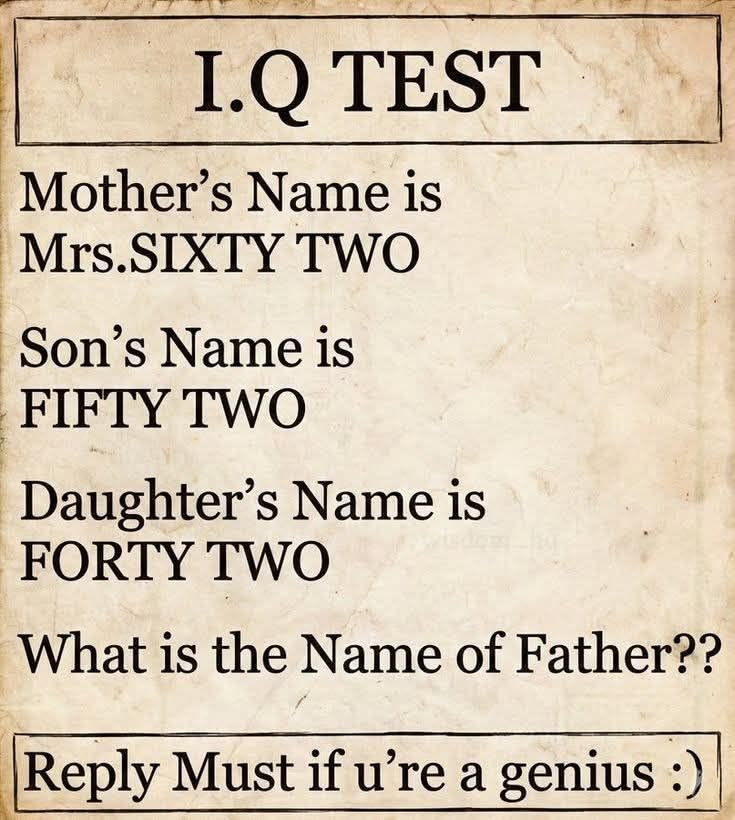
The “I.Q. Test” shown in image_83cc82.jpg plays on the fact that human brains are incredible pattern-recognition engines. We are constantly searching for sequences (e.g., 62, 52, 42). The joke or “riddle” aspect relies on lateral thinking—the ability to approach a problem from an unexpected direction. By focusing entirely on the numbers, your brain potentially overlooks the social context provided by the titles (Mother, Son, Daughter).
Practical Tips for Logical Reasoning
Whether you are solving a social media riddle or analyzing a complex financial loan document, the principles of logical reasoning remain the same:
- Identify the Core Question: Often, the fluff surrounding a problem is designed to distract you.
- Define Your Terms: In image_83cc82.jpg, the “titles” are as important as the names themselves.
- Test Your Hypothesis: If you think the answer is “Thirty Two,” ask yourself why. Does it fit the pattern, or does it fit the logic of the scenario?
Common Mistakes in Logic Puzzles
The most common mistake is overthinking. We often assume that because a puzzle labels itself an “I.Q. Test,” it must be mathematically complex. In reality, the most effective riddles are often the simplest ones, relying on wordplay or common sense rather than advanced algebra.
- Fact: The human brain often consumes 20% of your total energy intake, and puzzles that challenge your logic can actually be quite an intensive task for your neural pathways!
The Importance of Mental Health
Just as we invest in health insurance or long-term financial planning to secure our future, we should invest in the health of our minds. Engaging in puzzles is a low-stress way to provide “mental maintenance.” It keeps your problem-solving skills sharp and provides a much-needed break from the mundane stresses of work and life.
If you are looking for more ways to keep your mind active, check out our piece on the benefits of continuous learning and professional development.