
Have you ever wondered why you react to relationships, decisions, and stress the way you do? In the world of self-discovery, two powerful systems have captured global fascination: the Myers-Briggs Type Indicator (MBTI) and the ancient art of Palmistry (chiromancy). While one relies on cognitive psychology, the other reads the physical maps etched onto our hands.
When these two worlds collide, they reveal incredible patterns about our subconscious minds.
This viral personality test focuses entirely on the Heart Line—the major horizontal line running across the top of your palm just below your fingers. In palmistry, this line governs your emotional core, empathy, and intuitive processing. In psychology, these same traits dictate your MBTI preferences, particularly whether you are driven by Feeling (F) vs. Thinking (T) or Introversion (I) vs. Extraversion (E).
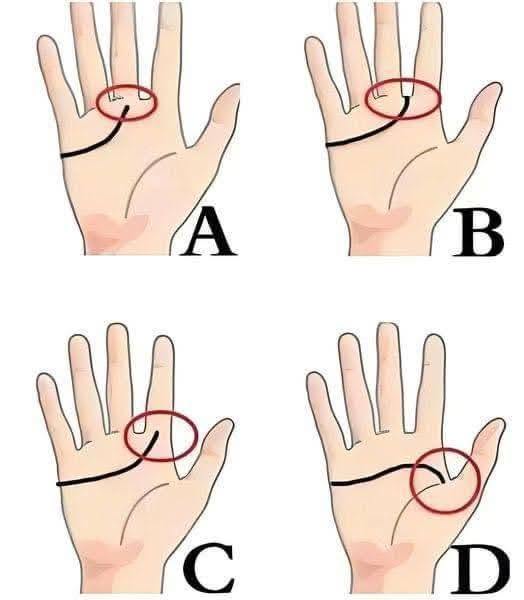
Take a close look at your dominant hand, match your heart line to A, B, C, or D, and discover which of the 16 MBTI personality types aligns with your true nature.
Type A: The Heart Line Ending Below the Middle Finger
The Rational Leader and Analytical Architect
If your heart line curves upward and stops directly beneath your middle finger (the finger of Saturn, representing structure, discipline, and wisdom), you possess an emotionally controlled, highly independent nature. You don’t wear your heart on your sleeve; instead, you filter your emotions through a lens of logic and objective reality.
[Type A Line] ──> Focuses on Saturn (Logic/Structure) ──> Core Trait: Rational Independence
Associated MBTI Personalities:
- INTJ (The Architect): Strategic, analytical, and intensely independent. You see life as a giant chessboard and prefer to make decisions based on cold facts rather than fleeting emotions.
- ENTJ (The Commander): Bold, imaginative, and strong-willed. You use your emotional restraint to lead teams efficiently and solve complex institutional problems.
- ISTJ (The Logisticist): Practical, fact-minded, and intensely reliable. Your emotions are grounded in duty, tradition, and concrete evidence.
- ESTJ (The Executive): Excellent administrators who excel at managing things, people, and structural blueprints.
Your Deep Personality Profile:
You are a natural-born problem solver. When a crisis strikes, you don’t panic or look for emotional comfort; you immediately look for a practical solution. In relationships, you value competence, intellectual stimulation, and personal space. You show love through actions, security, and loyalty rather than dramatic declarations. Your biggest strength is your level-headedness, but your blind spot can occasionally be seen as emotional detachment or a reluctance to open up to others.
Type B: The Heart Line Ending Between the Middle and Index Fingers
The Empathetic Diplomat and Harmonious Supporter
If your heart line ends precisely in the valley between your middle and index fingers, you represent the ultimate emotional balance. This position bridges the logical structure of the middle finger with the idealistic, ambitious nature of the index finger (the finger of Jupiter). You are deeply considerate, tactful, and highly perceptive of other people’s feelings.
Associated MBTI Personalities:
- INFJ (The Advocate): Quiet and mystical, yet deeply inspiring and tireless idealists. You absorb the emotions of the room instantly.
- ENFJ (The Protagonist): Charismatic and inspiring leaders, able to mesmerize their listeners and build deep communal harmony.
- ISFJ (The Defender): Very dedicated and warm protectors, always ready to defend their loved ones and maintain social safety nets.
- ESFJ (The Consul): Extraordinarily caring, social, and vibrant people who are always eager to help and organize community connection.
Your Deep Personality Profile:
You possess a high degree of emotional intelligence (EQ). You naturally understand the unspoken social dynamics in a room and work tirelessly to ensure everyone feels included, safe, and heard. You dislike unnecessary conflict and will go out of your way to mediate disagreements. In your personal life, you are incredibly loyal and warm, though you have a tendency to put other people’s needs ahead of your own, which can lead to emotional burnout if you don’t set firm boundaries.
Type C: The Heart Line Ending Below the Index Finger
The Passionate Idealist and Visionary Creative
If your heart line stretches all the way across your palm to end directly beneath your index finger (the finger of Jupiter, representing authority, high ideals, pride, and philosophy), you are guided by a profound inner compass. You are an idealist who dreams big, feels deeply, and approaches life with intense passion and high expectations.
Associated MBTI Personalities:
- INFP (The Mediator): Poetic, kind, and altruistic people, always eager to help a good cause and live authentically.
- ENFP (The Campaigner): Enthusiastic, creative, and sociable free spirits, who can always find a reason to smile and innovate.
- INTP (The Logician): Innovative inventors with an unquenchable thirst for knowledge and abstract structural possibilities.
- ENTP (The Debater): Smart and curious thinkers who cannot resist an intellectual challenge or an opportunity to re-engineer concepts.
Your Deep Personality Profile:
You do not settle for ordinary realities. You want your career, your relationships, and your creative projects to have profound meaning. Because your line reaches the mount of idealism, you hold yourself and others to very high standards. This makes you an incredible source of inspiration, a passionate advocate for justice, and an inventive thinker. However, your blind spot is vulnerability to deep disappointment when the world, or the people in it, fail to live up to the perfect ideals you have built in your mind.
Type D: The Heart Line Curving Downward Toward the Thumb
The Grounded Realist and Adaptable Pragmatist
If your heart line takes a sharp downward turn, curving toward the base of your thumb (intersecting or pointing toward the life line), you possess a deeply pragmatic, self-protective, and experiential personality. You do not get lost in abstract fantasies or romantic ideals. You view life through the lens of lived experience, sensory facts, and immediate reality.
Associated MBTI Personalities:
- ISTP (The Virtuoso): Bold and practical experimenters, masters of all kinds of tools and real-world troubleshooting.
- ESTP (The Entrepreneur): Smart, energetic, and very perceptive people, who truly enjoy living on the edge and taking calculated risks.
- ISFP (The Adventurer): Flexible and charming artists, always ready to explore and experience something completely new.
- ESFP (The Entertainer): Spontaneous, energetic, and enthusiastic people—life is never boring around them.
Your Deep Personality Profile:
You are highly adaptable and possess unmatched survival instincts. Instead of worrying about the distant future or analyzing complex emotional subtexts, you react to what is happening right here, right now. You are hands-on, action-oriented, and appreciate tangible results. In social settings, you are highly observant and can read a person’s physical cues instantly. You value freedom and autonomy above all else, preferring to learn through direct action rather than reading manuals or debating theories.
The Analytical Comparison: How Palm Lines Map to Cognitive Functions
To better visualize how your physical traits align with psychological frameworks, consider this structural layout of lines and processing styles:
| Palm Type | Heart Line Destination | Dominant Cognitive Style | Key MBTI Core Traits |
| A | Below Middle Finger | Thinking over Feeling ($T > F$) | Analytical, Independent, Objective |
| B | Between Fingers | Balanced Feeling and Intuition | Empathetic, Diplomatic, Harmonious |
| C | Below Index Finger | Intuitive Feeling ($N + F$) | Idealistic, Visionary, Deeply Passionate |
| D | Curving to Thumb | Sensing and Practical Action ($S$) | Realist, Highly Adaptable, Pragmatic |
How to Apply These Insights to Your Daily Life
Understanding your combined palmistry and MBTI profile isn’t just about labeling yourself—it’s a tool for personal growth, career alignment, and building stronger interpersonal relationships.
- For Career Growth: If you belong to Type A or C, you will thrive in environments that challenge your intellect, give you creative autonomy, or allow you to build complex strategies. If you belong to Type B or D, you excel in roles that require high emotional intelligence, real-time crisis management, or deep human connection.
- For Relationship Harmony: Recognizing how you process emotions helps you communicate your needs. A Type A individual needs to remember that their partners might require more verbal validation, while a Type B individual must actively practice saying “no” to protect their energetic well-being.
- For Financial Peace of Mind: Knowing your behavioral tendencies allows you to plan for the long term. Practical types can leverage their natural discipline, while spontaneous types can find structure by looking into tailored security measures, investment plans, or reliable insurance options to protect their freedom.
Final Thoughts
Whether you lean into the psychological algorithms of the 16 MBTI profiles or the ancestral wisdom written on the palms of your hands, both paths lead to the same destination: self-awareness. By looking at the unique lines that form your hands, you can gain a deeper appreciation for your cognitive gifts, accept your emotional patterns, and navigate your life’s journey with clarity and confidence.
Which heart line did you find on your hand, and how accurately does it reflect your true personality type? Share this test with your inner circle to discover their unique behavioral blue-prints!