
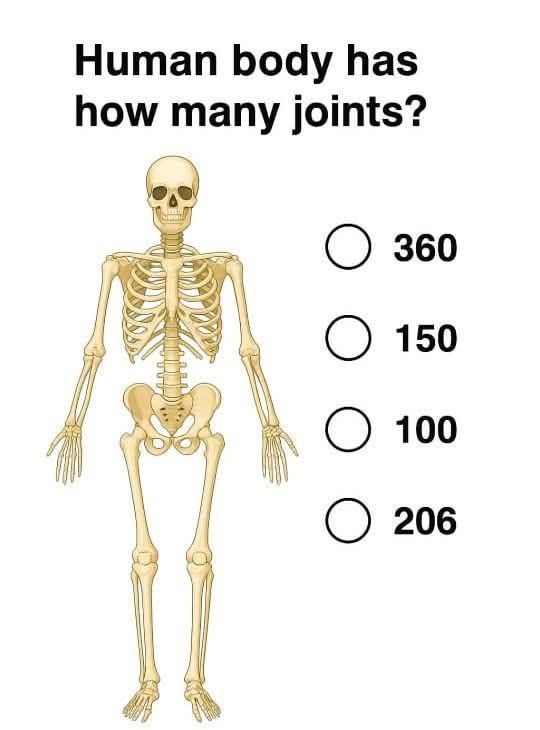
Social media loves a good rapid-fire trivia question, and health quizzes are currently dominating timelines. They seem incredibly straightforward at first glance, but they are specifically designed to exploit common misconceptions and catch casual scrollers off guard.
This viral anatomy question features a classic medical diagram of a skeleton and poses a simple question: “Human body has how many joints?” If your automatic instinct was to confidently lock in 206, you are in the vast majority—but you are also completely wrong! Don’t worry, thousands of people are failing this exact test every day in the comments section.
Here is the definitive, scientifically accurate breakdown of the answer and why your brain automatically falling for the trick says a lot about human memory patterns.
The Answer: Why 206 is the Ultimate Trick Option
The core reason this quiz goes viral is that it perfectly weaponizes a deeply embedded piece of childhood trivia. When we are in school, biology classes hammer one specific skeletal fact into our brains: The adult human skeleton has 206 bones.
Because bones and joints are intrinsically linked in our minds, our working memory immediately grabs that familiar “206” figure and applies it to the question. However, a joint is defined as any point where two or more bones meet to allow movement or provide structural support. Because multiple bones connect at various complex intersections (especially in your hands, feet, and spine), the number of joints significantly outnumbers the total number of bones.
The correct answer to the riddle is 360 joints.
Breaking Down the Anatomy: Where Are All 360 Joints?
To understand how the human body packs an incredible 360 joints into a frame of just 206 bones, medical professionals categorize them into distinct functional zones across the skeletal system:
1. The Spine and Thorax (147 Joints)
Your vertebral column is a masterpiece of complex engineering. Between the cervical, thoracic, and lumbar vertebrae, along with the connections to your ribs, your torso alone contains nearly half of all the joints in your entire body. This massive concentration allows for the bending, twisting, and shock absorption required for daily movement.
2. The Upper Limbs, Hands, and Fingers (88 Joints)
Think about how incredibly articulate your hands are compared to the rest of your body. From your shoulders and elbows down to the intricate mechanics of your wrists, knuckles, and fingertips, your upper limbs require 88 separate joint structures to give you fine motor control and grip strength.
3. The Lower Limbs, Pelvis, and Feet (39 Joints)
While your legs and feet are built more for stability and weight-bearing than delicate dexterity, they still require 39 joints. This includes the major power centers like your hips and knees, as well as the complex shock-absorbing joints running through your ankles and toes.
4. The Skull and Face (86 Joints)
This is the part that catches most people completely by surprise. We tend to view the skull as one solid piece of bone, but it is actually made up of separate plates connected by specialized, immovable joints called sutures. Combined with the jaw and the delicate bones of the inner ear, your head contains 86 joints.
Not All Joints Are Made Equal: The 3 Main Types
When people visualize a joint, they usually picture a highly mobile hinge like a knee or an elbow. In reality, anatomical joints operate under three entirely different structural categories:
- Synovial Joints (Freely Movable): These are the famous joints we actively think about. They are filled with synovial fluid to reduce friction and include your shoulders, hips, knees, and knuckles.
- Cartilaginous Joints (Partially Movable): Connected entirely by thick cartilage, these joints allow for very limited movement. A prime example is the joints connecting your ribs to your sternum, which expand slightly when you breathe.
- Fibrous Joints (Immovable): These joints are bound tightly together by tough, fibrous tissue and do not move at all. The sutures holding your skull plates together fall into this category.
Taking Care of Your 360 Joints
Understanding the sheer complexity of your structural anatomy highlights exactly why proactive joint care is such a critical component of long-term health and longevity. Whether you are hitting a personal record at the gym, practicing yoga, or simply navigating a busy workday, keeping those 360 connection points running smoothly requires conscious lifestyle choices.
Staying well-hydrated keeps your synovial joints lubricated, while a balanced diet rich in anti-inflammatory foods, omega-3 fatty acids, and essential vitamins supports cartilage health. Just like protecting your family’s overall well-being with robust health and dental insurance frameworks, prioritizing low-impact mobility exercises and strength training ensures your skeletal alignment stays strong, flexible, and pain-free for decades to come.
Did you fall for the 206 trap?
Drop your original guess down below and share this quick anatomy check with your friends to see who can successfully separate their bones from their joints!