
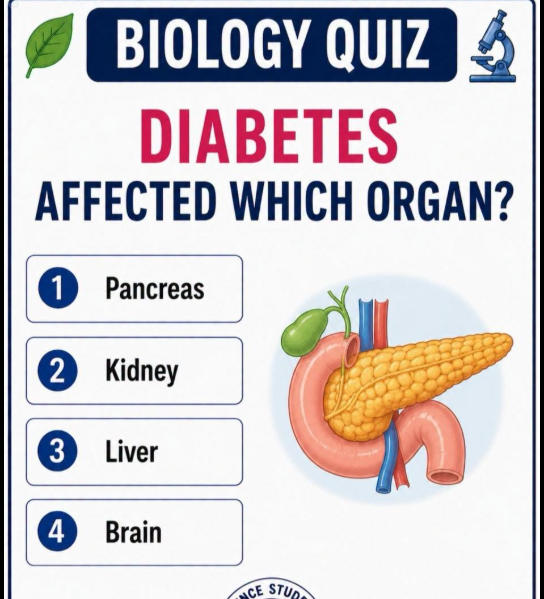
Social media timelines are currently flooded with quick-fire educational challenges, and the latest one to spark massive debate in the comment sections is a straightforward medical graphic asking: “Diabetes affected which organ?”
The image features four clear choices: 1) Pancreas, 2) Kidney, 3) Liver, and 4) Brain, alongside a detailed medical illustration of an organ nestled against the digestive tract.
While middle school biology students might pick the right answer instantly, the question actually highlights a fascinating medical truth: though the disease originates in one specific place, its long-term effects create a domino effect across the entire human body.
Here is the definitive breakdown of the correct answer, the science behind how it works, and why the other choices aren’t entirely wrong when it comes to chronic health.
The Correct Answer: Why Option 1 is the Root Cause
The correct answer to the quiz is 1) Pancreas. The anatomical illustration featured right next to the options is a textbook drawing of the human pancreas, flanked by the curve of the duodenum and the gallbladder.
The pancreas is a long, flat gland located deep in the abdomen, tucked behind the stomach. It plays a dual role in our survival: it acts as an exocrine gland by producing digestive enzymes, and as an endocrine gland by releasing vital hormones directly into our bloodstream.
When it comes to diabetes, the pancreas is ground zero. Inside the pancreas are specialized clusters of cells called the Islets of Langerhans. Within these clusters, beta cells have one incredibly crucial job: manufacturing and secreting insulin.
Insulin and the Engine of the Human Body
To understand why the pancreas is the primary organ behind diabetes, you have to look at how our bodies process energy. Every time you eat carbohydrates, your digestive system breaks them down into glucose (sugar), which enters your bloodstream.
Glucose is the primary fuel source for your cells, but it cannot enter them on its own. It needs a key. Insulin is that key. * Type 1 Diabetes: This is an autoimmune condition where the body’s immune system mistakenly identifies the pancreas’s beta cells as foreign invaders and completely destroys them. Because the pancreas can no longer produce insulin, glucose builds up in the bloodstream while the cells starve.
- Type 2 Diabetes: In this variation, the pancreas initially produces insulin normally, but the body’s cells build up a resistance to it. To compensate, the pancreas works overtime, pumping out more and more insulin to force the glucose into cells. Eventually, the pancreas experiences “burnout,” and its ability to produce sufficient insulin drops off permanently.