
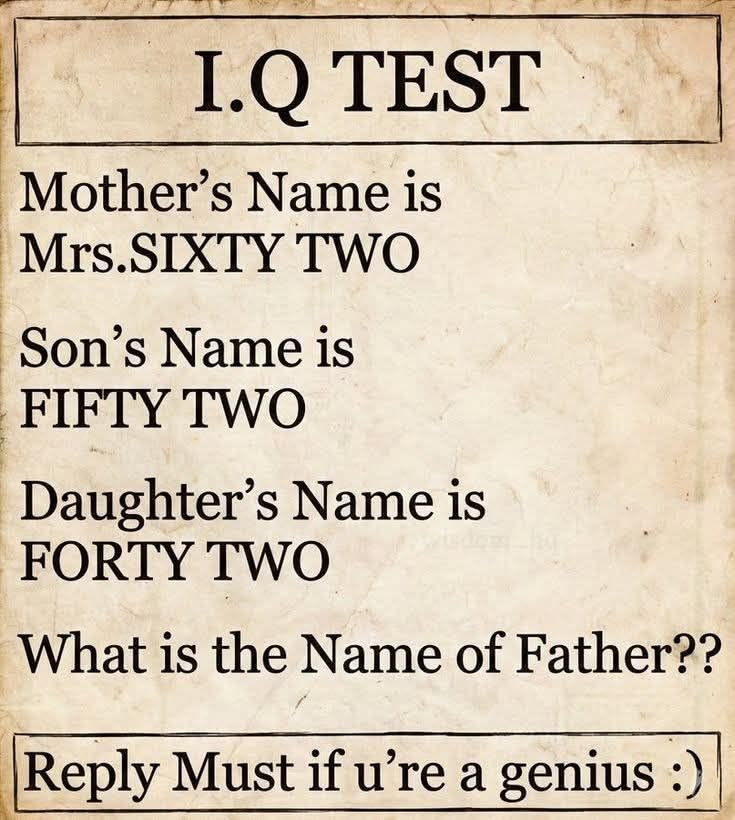
There is something inherently satisfying about solving a riddle. Whether it is a complex mathematical equation or a clever play on words like the one featured in image_83cc82.jpg, brain teasers force us to step outside our habitual patterns of thought. They require us to look past the obvious and consider the structure of the information presented to us, rather than just the literal meaning.
The Science of Cognitive Flexibility
Brain teasers like the one in image_83cc82.jpg are excellent exercises in cognitive flexibility. This refers to your brain’s ability to switch between thinking about two different concepts or to think about multiple concepts simultaneously. When you first read the names in image_83cc82.jpg—Sixty Two, Fifty Two, Forty Two—your brain is primed to look for a numerical progression. However, the puzzle asks a question that requires a different type of reasoning.
- Tip: If you find yourself stuck on a puzzle, step away for five minutes. Sometimes, a “background process” in your brain will solve the problem while you are focusing on something else.
- Insight: Solving logic puzzles regularly can help maintain mental sharpness, much like regular physical exercise keeps your body in peak condition.
If you are interested in expanding your logical repertoire, you might enjoy reading about improving critical thinking skills in an educational setting or exploring how logic impacts strategic business decision-making.