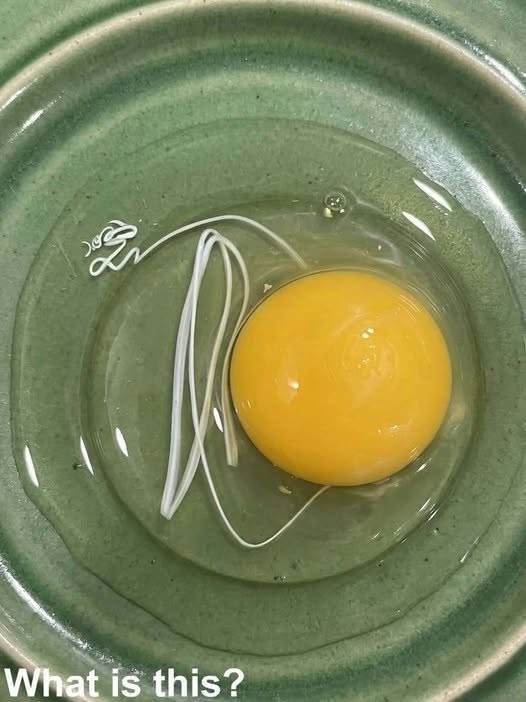
You crack an egg into the pan for breakfast, and there it is — a twisted, rope-like white strand clinging to the yolk. For a split second, your brain jumps to the worst-case scenario. Is it a worm? An embryo? Something that shouldn’t be in there at all?
Take a breath. What you’re looking at has a name, a job, and absolutely nothing to do with anything alive. It’s one of the most misunderstood parts of an egg, and once you understand what it does, you’ll never look at breakfast with suspicion again.
What Is That White String, Exactly?
The white, cord-like strand attached to the yolk is called a chalaza (pronounced kuh-LAY-zuh). Most eggs actually have two of them, one anchored on each side of the yolk, though you’ll often only notice one clearly since the other can be harder to spot.
Where Does It Come From?
The chalazae form naturally while the egg is developing inside the hen. As the yolk rotates on its way through the reproductive tract, thin strands of protein twist around it, eventually hardening into that rope-like shape you see when you crack the egg open.
So What Does It Actually Do?
The chalaza isn’t decorative and it isn’t a defect. It functions like a built-in stabilizer, holding the yolk suspended in the center of the egg white so it doesn’t roll around and press against the shell. Think of it as a natural shock absorber, keeping the yolk cushioned and centered every time the egg gets jostled, whether that’s during shipping, storage, or just sitting in your fridge door.