Modern car interiors are masterpieces of micro-engineering. Every curve, compartment, and slot in your vehicle’s cabin has been thoroughly debated, tested, and molded by industrial designers to maximize space. Yet, many of these thoughtful details are so subtle that drivers completely miss their intended functionality for years.
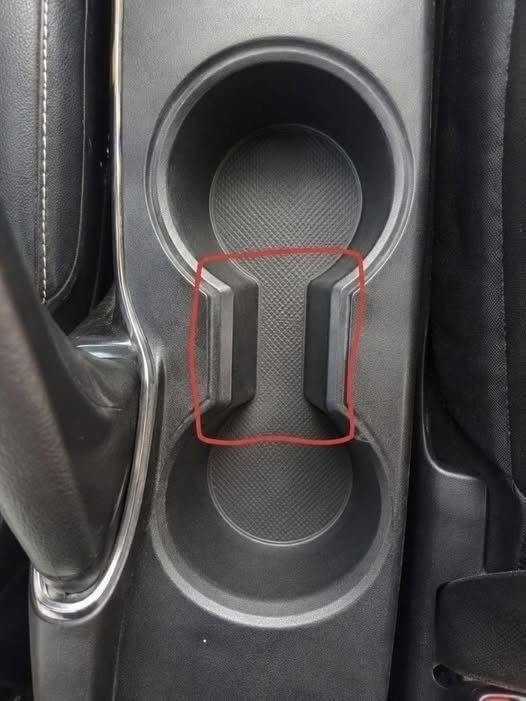
A prime example is the distinct, open channel or gap that connects two adjacent cup holders in the center console. If you’ve ever looked down while shifting gears and wondered why your cup holders aren’t just two perfectly isolated circles, you aren’t alone.
It turns out that this little gap isn’t a shortcut in plastic manufacturing—it’s a deliberate design feature meant to solve two very specific daily driving inconveniences. Here is exactly what that console gap is engineered for.
1. The Primary Purpose: Accommodating Coffee Mug Handles
The number one reason automotive engineers design a connecting channel between cup holders is to accommodate travel mugs and coffee cups with side handles.
If the center console consisted of two unbroken, perfectly circular wells, a standard ceramic or insulated mug with a rigid handle would sit crookedly on the rim. The uneven balance would make the hot beverage highly prone to spilling every time you accelerate, brake, or round a sharp corner.
By molding an open gap between the two wells, designers created a dedicated clearance zone. When you place a mug into either holder, the handle slides perfectly into the middle channel, allowing the base of the cup to rest completely flat against the rubberized bottom matrix.
2. The Secondary Purpose: Clever Storage for Essential Items
Beyond securing your morning caffeine fix, industrial designers frequently utilize this shared space to serve as a secondary dock for small items you need to keep within arm’s reach.
• Secure Smart Phone Docking
Because smartphones have grown progressively larger, they often slide out of small dashboard trays during transit. Many modern center consoles are engineered so that the width and depth of the middle gap function perfectly as a vertical slot to slide your phone into sideways, keeping the screen stable and visible for navigation apps.
• Key Fob and Sunglasses Rest
When you don’t want your keys rattling around deep inside a cup holder well or buried under loose change, the elevated middle ridge acts as an ideal shelf to lay your key fob, sunglasses, or parking garage tickets flat.
Form Meets Function in the Modern Cabin
The evolution of the center console highlights how automotive design adapts to consumer habits. In early vehicle models, cup holders were an afterthought—often consisting of shallow indentations on the inside of a glove compartment door. Today, they are highly optimized zones designed to anchor everything from oversized water bottles to delicate morning mugs.
CENTER CONSOLE ANATOMY
+-----------------------+---------------------------------------------------+
| Feature               | Engineering Intent                                |
+-----------------------+---------------------------------------------------+
| Circular Wells        | Anchors standard cans, bottles, and fast-food cups|
| Connecting Channel    | Provides drop-down clearance for mug handles      |
| Textured Rubber Base  | Reduces vibration, noise, and minor fluid slips  |
+-----------------------+---------------------------------------------------+
The Bottom Line
Don’t feel bad if you’re just learning this today—car manufacturers are notorious for hiding incredibly useful ergonomic solutions in plain sight without printing them in the owner’s manual. The next time you grab an insulated travel mug for a long road trip, you can slide it into the console with total confidence, knowing exactly why that little gap was sculpted there in the first place.