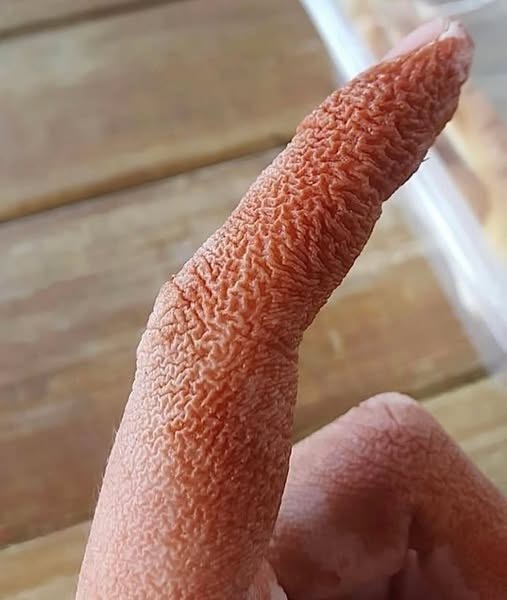
We have all experienced “pruning”—the distinct, heavily wrinkled appearance our fingers and toes take on after an extended bath, swimming session, or dishwashing chore. For decades, the common consensus was that this texturing was a simple chemical reaction, a result of the outer layer of skin absorbing water and expanding.
However, medical science has revealed that pruning is an active, structural response managed entirely by the human nervous system. When this wrinkling happens excessively, or occurs suddenly without prolonged water exposure, it acts as a highly visible indicator of internal physiological changes.
Let’s explore the neurological purpose behind pruning, what triggers an exaggerated response, and when your skin is trying to tell you something deeper about your health.
The Neurological Science Behind Pruning
In the 1930s, surgeons noticed a fascinating phenomenon: patients with localized nerve damage in their hands did not get wrinkled fingers when their hands were soaked in water. This discovery completely disproved the old theory of passive water absorption.
Today, we know that pruning is an active vasoconstriction response controlled by the autonomic nervous system—the same system that regulates your heart rate, digestion, and breathing. When the nerves in your extremities detect moisture, they send a signal to the blood vessels just beneath the skin to constrict, narrowing their path. As the blood vessels shrink, the tissue volume underneath drops, pulling the skin downward to form deep, uniform ridges.
The Evolutionary Advantage: Wet Grip
Why did the human body evolve to actively wrinkle its skin in wet environments? Evolutionary biologists believe it served as a vital survival mechanism.
The deep ridges act exactly like the specialized treading on rain tires. They create channels that allow water to drain away rapidly when you touch a surface, giving our ancestors a significantly better grip on wet tools, slippery rocks, and damp environments.
What Causes Sudden or Severe Pruning?
If your fingers look like the image above after only a brief moment of moisture, or if you experience a dramatic pruning effect out of nowhere, several underlying systemic factors could be at play:
1. Autonomic Nervous System Dysregulation
Because wrinkling is entirely mediated by your sympathetic nervous system, any condition that alters nerve signaling can lead to an exaggerated response. Structural nerve hypersensitivity, early-stage peripheral neuropathy, or dysautonomia can cause the blood vessels to overreact to tiny changes in temperature or minor moisture.
2. Acute Dehydration
When your body faces a severe lack of fluids, cellular hydration drops across all tissues. The skin on your hands loses its natural elasticity and plumpness. Under these conditions, the underlying tissue lacks the fluid volume to keep the skin taut, causing standard friction or minimal moisture to create deep, long-lasting wrinkles.
3. Severe Electrolyte Imbalances
The cellular pump mechanism that tells your blood vessels to constrict depends heavily on a precise balance of minerals, specifically sodium, potassium, and magnesium. If your electrolyte levels drop due to intense workouts, dietary shifts, or metabolic changes, it can trigger involuntary vascular spasms in the hands, mimicking the water-induced pruning response.
4. Thyroid and Hormonal Shifts
Your thyroid gland regulates your body’s overall metabolic rate, skin moisture levels, and circulation patterns. Hypothyroidism (an underactive thyroid) can lead to chronically dry, cool skin and sluggish blood flow in the extremities, making the fingers highly prone to sudden wrinkling and slower recovery times.
Managing Your Skin and Nerve Health
If you notice your body reacting with hyper-pruning tendencies, supporting your vascular system and nerve paths can help restore balance:
-
Optimize Hydration Cycles: Ensure you are consuming adequate water alongside trace minerals to keep the underlying skin matrix fully plumped and resilient.
-
Monitor Extremity Circulation: Keep your hands protected from extreme, sudden temperature drops, which can overstimulate the autonomic blood vessel response.
-
Track Accompanying Symptoms: Note if the wrinkling is paired with numbness, tingling, or chronic coldness in your fingers, as these are helpful clues to share with a health professional during routine checkups.
The Bottom Line
Our skin is a dynamic, living interface that constantly adjusts to protect us. While standard pruning is a brilliant evolutionary trait designed to help us navigate wet environments, a sudden shift toward hyper-wrinkling is a helpful reminder to check in on your hydration, nerve health, and internal balance.