
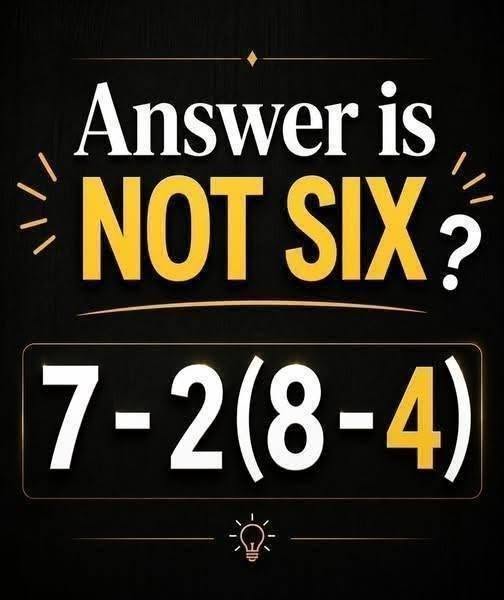
 Every few months, a deceptively simple math equation sweeps through social media, generating hundreds of thousands of comments, arguments, and conflicting answers. The latest viral puzzle to break the internet is:
At first glance, it looks like elementary school homework. Yet, adults worldwide are splitting into opposing camps, fiercely defending two completely different answers: -1 and 6.
The reason this specific problem goes viral isn’t because the math is overly complex; it is because it is perfectly engineered to exploit a common flaw in how the human brain remembers basic school rules. Let’s break down the underlying mathematical science and resolve the debate once and for all.
The Root of the Confusion: Misinterpreting PEMDAS / BODMAS
To solve any mathematical string with multiple operations, students are taught an acronym to remember the absolute order of precedence. In the United States, this is typically PEMDAS (Parentheses, Exponents, Multiplication/Division, Addition/Subtraction). In the UK, India, and many other regions, it is known as BODMAS (Brackets, Orders, Division/Multiplication, Addition/Subtraction).
The mistake millions make is reading these acronyms too literally from left to right, assuming that because the letter “A” (Addition) or “M” (Multiplication) comes earlier in the word, that operation must always happen first.
The Fatal Flaw That Leads to “6”
Those who arrive at the incorrect answer of 6 usually execute the problem like this:
-
They look at the front of the equation and subtract 2 from 7 first: $7 – 2 = 5$.
-
Then they solve the parentheses: $(8 – 4) = 4$.
-
Finally, they multiply the two numbers: $5 \times 4 = 20$ (or variations that incorrectly end up at 6 by subtracting later).
By performing the subtraction ($7 – 2$) out of order, the fundamental mathematical logic is broken.
The Correct Step-by-Step Mathematical Solution
To find the true, mathematically undeniable answer, we must strictly apply the standard order of operations. Let’s walk through the formula correctly.
THE TRUE MATHEMATICAL PATHWAY
Equation: 7 - 2(8 - 4)

Step 1: Simplify Parentheses ───> (8 - 4) = 4
Remaining: 7 - 2(4)

Step 2: Multiplication ──────────> 2 × 4 = 8
Remaining: 7 - 8

Step 3: Subtraction ─────────────> 7 - 8 = -1
Step 1: Parentheses (Brackets) First
The absolute highest priority in any algebraic string belongs to the operations inside parentheses.
Now, substitute that back into our main equation. The expression shrinks to:
Step 2: Multiplication Before Subtraction
This is where the viral trap catches most people. The term $2(4)$ is a shorthand algebraic notation that explicitly means 2 multiplied by 4. Because multiplication holds a higher operational priority than subtraction, we must multiply before touching the 7 at the front.
Now our equation is simplified down to its final two terms:
Step 3: Final Subtraction
Now, we perform the final subtraction. Because we are subtracting a larger number from a smaller one, the result crosses the zero threshold into negative numbers:
The definitive, mathematically accurate answer is $-1$.
THE EVALUATION MATRIX
+-------------------------+-------------------------+-------------------------+
| Step Sequence           | Incorrect Method        | Correct Order (PEMDAS)  |
+-------------------------+-------------------------+-------------------------+
| 1. Parentheses (8 - 4)  | Resolved to 4           | Resolved to 4           |
| 2. Next Operation       | Subtracted 7 - 2 = 5    | Multiplied 2 × 4 = 8    |
| 3. Final Calculation    | 5 × 4 = 20 (or 6)       | 7 - 8 = -1              |
| Final Verdict           | WRONG                   | CORRECT                 |
+-------------------------+-------------------------+-------------------------+
Why Do These Traps Matter?
While arguing over a basic equation on Facebook is lighthearted fun, understanding the strict order of operations is a foundational pillar for computer programming, financial accounting algorithms, and engineering.
Calculators and modern computer languages are hardwired to follow these exact logic rules. If you type 7 - 2 * (8 - 4) into Google, an Excel spreadsheet, or a scientific calculator, it will instantly output -1. It serves as a great reminder that in mathematics, rules aren’t just guidelines—they are the logic that keeps the digital world running smoothly.