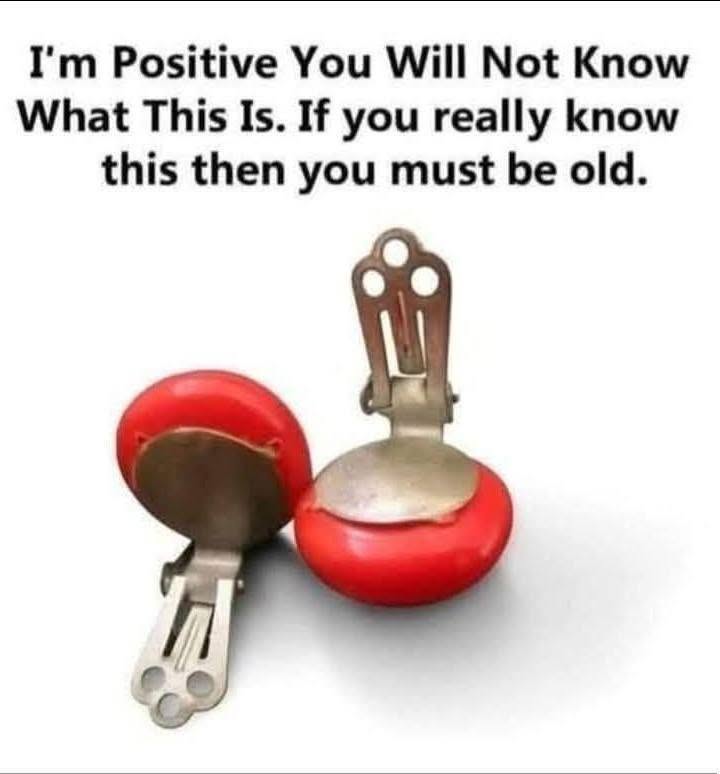
If you have scrolled through your Facebook feed lately, you have probably run into this text-heavy image challenging your memory: “I’m Positive You Will Not Know What This Is. If you really know this then you must be old.”
The image displays a pair of bright red, round, button-like objects with specialized metal levers attached to the back. For Gen Z and younger Millennials, this looks like a bizarre mechanical component, a vintage kitchen tool, or a strange utility clip.
But for anyone who grew up between the 1950s and the 1980s, this image doesn’t just represent an object—it unlocks a flood of sensory memories. It smells like vintage Aquanet hairspray, evening perfume, and the crinkle of a velvet jewelry box.
Here is the definitive answer to the viral puzzle, the fascinating history of why this design completely dominated the fashion world, and why it eventually vanished into obscurity.
The Correct Answer: What Are They?
The objects in the image are Vintage Clip-On Earrings—specifically featuring the classic paddle-back clip mechanism.
Before the late 1960s and 1970s, the vast majority of women in Western society did not have pierced ears. Piercing was often viewed culturally as taboo, rebellious, or unsanitary, frequently associated with sailors or non-Western cultures. If a woman wanted to accessorize her ears with heavy, glamorous geometric shapes, she relied entirely on tension-based clips like the ones in the photo.
The specific design shown uses a tension spring paddle. You pull the metal lever back, place the decorative red button against the front of your earlobe, and snap the paddle shut against the back of your earlobe to hold it firmly in place.
The Rise and Fall of the Clip-On Empire
The evolution of how women attached heavy metal and plastic to their ears is a fascinating journey through industrial design:
- The Screw-Back Era (1900s–1930s): Early non-pierced earrings used a tiny threaded screw mechanism. While you could adjust the tightness, they took a long time to put on and frequently stripped or backed out.
- The Spring Clip-On Boom (1940s–1950s): Inventors patented the spring-loaded paddle back (seen in the image). Suddenly, putting on earrings was instantaneous. This allowed the mid-century fashion explosion of massive, heavy plastics (like Bakelite and Lucite) and oversized faux-pearl statement pieces.
- The 1980s Revival: Clip-ons enjoyed a massive structural comeback in the 1980s when the fashion trend demanded giant, shoulder-grazing geometric enamel and gold shields that were far too heavy for pierced ears to support without tearing the earlobe.
The Sensory Memory: The Unforgettable “Pinch”
What makes this specific post go viral in nostalgia groups is that every woman who wore them—or every child who snuck into their mother’s vanity to try them on—instantly remembers the physical sensation of wearing them.
While convenient, paddle-back clip earrings were notoriously unforgiving. Because they relied on a fixed factory spring tension, they didn’t care how thick your earlobe was.
Within an hour of wearing them, they would begin to throb. It was an unwritten rule of mid-century formal events that by hour three of a wedding or a dinner party, women would secretly unclip their earrings under the table and drop them into their evening purses just to let their throbbing, bright-red earlobes breathe.
🛑 Why Did They Disappear?
If you walk into a modern jewelry boutique today, finding a clip-on earring is incredibly rare. The utility faded from the mainstream due to three major cultural shifts:
- The Piercing Pagoda Revolution: In the 1970s, commercialized, sterile ear-piercing guns became standard in shopping malls across America, making ear piercing safe, cheap, and culturally mainstream for young girls.
- Lightweight Materials: Modern manufacturing allows for massive statement jewelry made from hollow metals, lightweight acrylics, and resins that pierced ears can easily hold without discomfort.
- The Loss Factor: Because clip-ons rely strictly on friction, a swift brush of a winter scarf or an enthusiastic hug could easily send one flying into oblivion, leaving women with mismatched sets.
Did you guess it right away?
Did this image immediately remind you of your grandmother’s vanity table, or did you have to check the comments to figure out what those metal paddles were for? Check out the full breakdown and see what other vintage items are trending in the link below!
Latest Post
- He Bought a Dead Island for $10,000 and Created the World’s Most Stunning National Park
 Imagine making a decision in the last four minutes before midnight that would change your entire life—and create a sanctuary for thousands of living creatures you’d never even met yet. That’s exactly what happened … Read more
 - That Stringy White Thing In Your Egg Yolk: Here’s What It Actually Is
 You crack an egg into the pan for breakfast, and there it is — a twisted, rope-like white strand clinging to the yolk. For a split second, your brain jumps to the worst-case scenario. … Read more
 - What Is That Tiny Hole in Your Nail Clippers Actually For?
 You’ve used a pair of nail clippers hundreds of times. You’ve trimmed, filed, and tossed them back in the drawer without a second thought. But somewhere on the handle, there’s a tiny round hole … Read more
 - Anti-Aging Claims: Fact vs. Fiction in Skincare
 Viral posts like image often promise drastic, immediate results—claiming that wrinkles will disappear and youth will return to your face with a simple, secret recipe. It is natural to be drawn to these ideas, … Read more
 - The Story Behind ‘Funeral Sandwiches’: A Comforting Culinary Tradition
 Food has an incredible ability to connect us to our history, our communities, and our most cherished—and sometimes somber—memories. When the term “funeral sandwiches” first pops up in conversation, it can certainly raise eyebrows. … Read more
 - Oregano: Separating Traditional Wisdom from Modern Claims
 The viral image makes bold assertions about the strength of oregano as an antimicrobial agent compared to household staples like lemon and garlic. While oregano—specifically oregano oil—has been studied for its potential properties in … Read more
 - Cinnamon and Honey: Exploring the History of a Traditional Remedy
 For centuries, across various cultures, cinnamon and honey have been touted as a powerful combination in traditional medicine. Whether utilized to soothe a scratchy throat or added to a morning wellness routine, this duo … Read more
 - Understanding Eye Floaters: When Should You Be Concerned?
 It can be startling to suddenly notice small shapes, spots, or squiggly lines drifting through your field of vision, especially when looking at a bright, clear background like a blue sky. These are known … Read more
 - Night Cramps: Understanding the Risk Factors and Real Causes
 Waking up in the middle of the night with a sudden, sharp pain in your calf is a distressing experience. Often, social media images like image_8f21e2.jpg circulate with vague, alarmist hints about the cause, … Read more
 - The Science of the Green Ring: Why Your Boiled Eggs Change Color
 If you have ever sliced into a perfectly hard-boiled egg only to find an unappealing greenish-gray ring around the yolk, you are not alone. It is a common kitchen frustration that leads many to … Read more