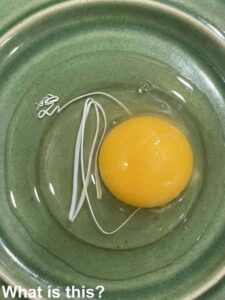
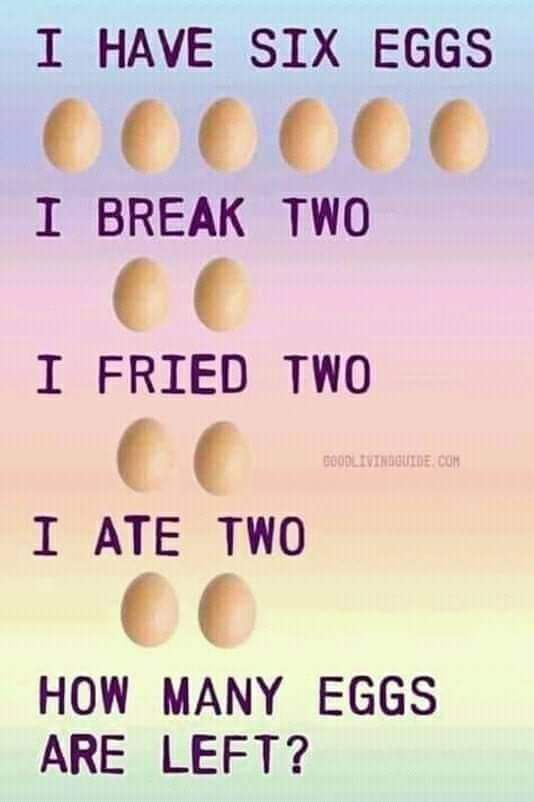
Internet riddles love to play with language, tense, and logic to trick your brain into overcomplicating simple math. One classic brain teaser that frequently makes the rounds on social media is the “Six Eggs” riddle, as shown in the image .
At first glance, it looks like a simple subtraction problem that leaves you with zero. But if you take a closer look at how the story unfolds, the real answer is much more satisfying.
Here is the complete breakdown and solution to the puzzle.
The Riddle Premise
As seen in, the text reads:
I HAVE SIX EGGS
I BREAK TWO
I FRIED TWO
I ATE TWO
HOW MANY EGGS ARE LEFT?The Definitive Answer
The correct answer is 4.
How It Works: The Logical Breakdown
The trick to this riddle lies in understanding that the actions described (breaking, frying, and eating) are not happening to separate groups of eggs. Instead, they are a sequential timeline of the exact same two eggs being prepared for breakfast.
Let’s look at the lifecycle of the eggs step-by-step:1. The Starting Total
- Statement: “I have six eggs.”
- Inventory: You start with 6 whole, intact eggs.
2. The Preparation (Breaking)
- Statement: “I break two.”
- Inventory: You take 2 eggs out of the 6 and crack them open.
- Remaining intact: 4 eggs.
- In the bowl/pan: 2 broken eggs.
- Total physical eggs left in your possession: 6 (4 whole + 2 broken).
3. The Cooking (Frying)
- Statement: “I fried two.”
- Inventory: You can’t fry an egg without breaking it first. Therefore, the 2 eggs you fry are the exact same 2 eggs you just broke.
- Remaining intact: 4 eggs.
- In the pan: 2 cooked eggs.
4. The Consumption (Eating)
- Statement: “I ate two.”
- Inventory: Naturally, you eat the 2 eggs you just fried. They are now gone.
- Remaining intact: 4 eggs.
Summary Table
ActionWhole Eggs LeftBroken/Cooked EggsTotal Eggs in PossessionStart606Break 2426Fry 242 (cooked)6Eat 2404
Why People Get It Wrong
The riddle is designed to trigger automatic subtraction.
When your brain reads “6… minus 2… minus 2… minus 2,” it instinctively wants to calculate 6 – 2 – 2 – 2 = 0.
The riddle also subtly switches tenses (“break” vs. “fried” and “ate”), which tricks some readers into thinking these are distinct events happening to different sets of eggs. However, standard culinary logic dictates that you must break an egg to fry it, and you must fry an egg to eat it.
Because you only ever processed two eggs through the entire cooking cycle, the other four eggs remain completely untouched and left over!