
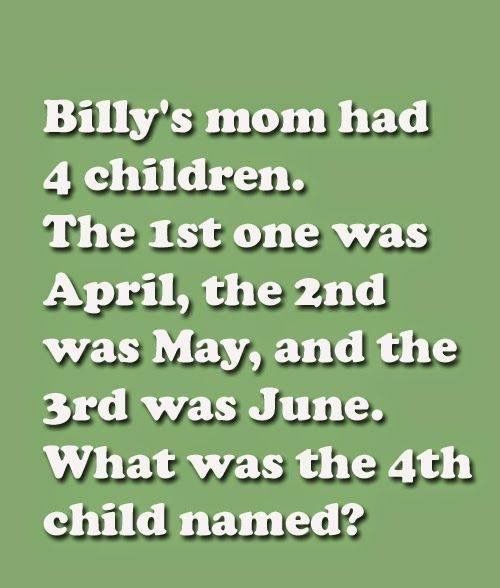
Word riddles are designed to exploit how our brains naturally seek out patterns. When a puzzle sets a clear rhythm, we eagerly jump onto the track and coast right past the actual answer. A perfect example of this cognitive traps is the classic family name puzzle shown in the image 7ddc90e827e0485d969468d222fb6b82.jpg.
If your immediate instinct was to name a specific summer month, you aren’t alone. However, looking back at the opening sentence reveals that the riddle has already handed you the solution.
The Riddle Premise
As seen in 7ddc90e827e0485d969468d222fb6b82.jpg, the text reads:
Billy’s mom had 4 children.
The 1st one was April, the 2nd was May, and the 3rd was June.
What was the 4th child named?The Definitive Answer
The fourth child’s name is Billy.
How It Works: The Logical Breakdown
The riddle relies on a very simple piece of possessive grammar in its very first clause. Let’s break down the facts explicitly stated in the text:
- The Subject: The mother in question is introduced right away as “Billy’s mom“.
- The Count: We are told this specific mother has a total of 4 children.
- The List: The riddle then systematically names three of those children:
- Child #1: April
- Child #2: May
- Child #3: June
- The Deduction: If Billy’s mom has four children, and three of them are April, May, and June, the remaining child must be Billy himself.
Why Our Brains Get Tricked
This riddle is a masterclass in establishing a false pattern, a psychological phenomenon known as priming.
When you read the sequence April, May, and June, your brain completely drops the context of the first sentence. Instead, it locks onto the calendar sequence of consecutive months. The subconscious automatically expects the next item in the pattern to be July.
By formatting the query as a fast-paced sequence, the puzzle tricks you into looking forward into the calendar year for an answer, rather than looking backward to the actual subject established at the very beginning of the sentence.