Lateral thinking riddles are a fantastic way to test our attention to detail. A classic example that frequently makes the rounds on social media is the “Five Sisters” puzzle, as displayed in the image c3edc5fe9d448483050bcca60006e4fd.jpg.
While it looks like a trick question or a riddle missing information, it actually gives you everything you need to deduce the exact right answer.
The Riddle Premise
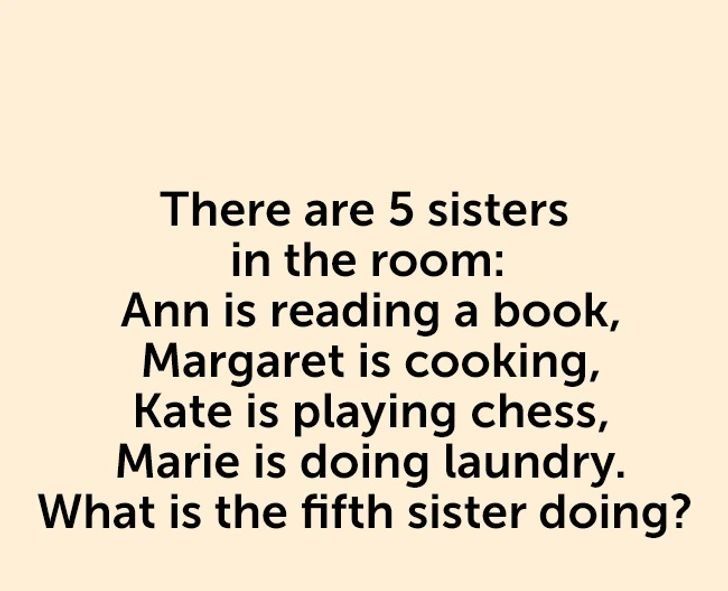
As seen in c3edc5fe9d448483050bcca60006e4fd.jpg, the text states:
There are 5 sisters in the room:
Ann is reading a book,
Margaret is cooking,
Kate is playing chess,
Marie is doing laundry.
What is the fifth sister doing?The Definitive Answer
The fifth sister is playing chess.
How It Works: The Logical Breakdown
To arrive at this answer, you don’t need to overthink the scenario or assume there is an unmentioned character. You simply have to look at the specific nature of the activities listed.
- Solitary Chores and Hobbies: Reading a book (Ann), cooking (Margaret), and doing laundry (Marie) are all independent activities. A person can easily do them completely by themselves.
- The Two-Player Game: Chess, however, is strictly a two-player game. Under normal circumstances, you cannot play a standard game of chess without an opponent.
- Connecting the Dots: Since the riddle states that all five sisters are in the same room, and Kate is currently playing chess, she must have an opponent. Since none of the other three sisters (Ann, Margaret, or Marie) are available because they are occupied with their own tasks, Kate’s opponent must be the mysterious fifth sister.
Therefore, the fifth sister is playing chess right across the board from Kate.Why People Get It Wrong
This brain teaser plays on a cognitive blind spot. When we read a list of items or activities, our brains tend to categorize each line as a completely isolated fact:
- Person A = Action A
- Person B = Action B
- Person C = Action C
Because we process the list linearly, we fail to naturally connect the social requirements of the activities mentioned. We get so caught up trying to invent a completely new hobby for a fifth person—like sleeping, studying, or hiding—that we overlook the basic rules of the board game staring right at us.